
When it comes to renting property, flexibility is often a top priority. That’s where a month a month rental agreement comes in. Unlike a fixed-term lease, this arrangement allows tenants and landlords to operate on a rolling monthly basis, offering adaptability for changing circumstances.
Understanding the month-to-month lease meaning, its advantages, and legal implications is crucial for both tenants and landlords. This guide will cover:
- Month-to-month lease meaning
- Key advantages and disadvantages
- Structure of a month-to-month rental agreement
- Differences between month-to-month vs fixed-term leases
- Tenant and landlord rights and responsibilities
- Tips, examples, and best practices
By the end of this guide, you’ll be equipped to manage or negotiate a month-to-month lease effectively in 2026.
What Is a Month-to-Month Lease? (Month-to-Month Lease Meaning)
A month-to-month lease is a rental agreement that automatically renews every month until either the landlord or tenant gives proper notice to end it.
Key features:
- Rolling agreement – No fixed end date; continues month by month
- Flexibility – Both parties can terminate with proper notice, typically 30 days
- Legally binding – Provides the same protections as standard leases
Example: Jane rents an apartment under a month-to-month lease. She decides to move to another city and gives her landlord 30 days’ notice. The lease ends after 30 days, giving her freedom to leave without penalties.
What is Accounts Payable? Definition, Process and Journal Entries
Advantages of Month-to-Month Contracts
Month-to-month contract advantages make this arrangement appealing for many renters and landlords:
- Flexibility for Tenants
- Ideal for students, temporary workers, or those anticipating relocation
- Ideal for students, temporary workers, or those anticipating relocation
- Short-Term Commitment
- No long-term lock-in like fixed-term leases
- No long-term lock-in like fixed-term leases
- Easier Adjustments
- Rent increases or policy changes can be implemented with notice
- Rent increases or policy changes can be implemented with notice
- Landlord Flexibility
- Can regain property quickly if needed
- Can regain property quickly if needed
- Trial Period for Tenants
- Allows renters to test the property or neighborhood before committing long-term
- Allows renters to test the property or neighborhood before committing long-term
Pro Tip: While month-to-month leases offer flexibility, tenants should carefully read notice requirements and rent adjustment clauses to avoid surprises.
Month-to-Month Rental Agreement Structure
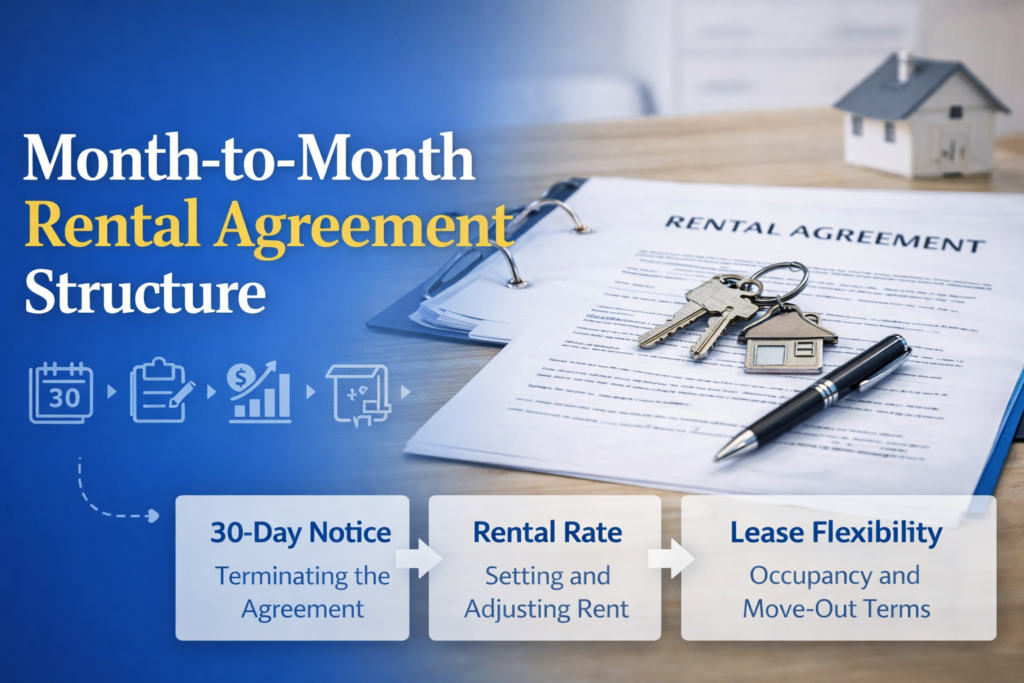
A month-to-month rental agreement outlines the terms, responsibilities, and rights of both parties. Key components include:
1. Parties Involved
- Landlord and tenant names and contact information
2. Property Details
- Rental address, unit number, and description of the premises
3. Rent Payment Terms
- Monthly rent amount
- Payment method and due date
- Late fees and penalties
4. Security Deposit
- Amount, conditions for refund, and legal compliance
5. Duration and Termination
- Rolling monthly agreement
- Notice period (commonly 30 days) for termination by either party
6. Responsibilities
- Maintenance, utilities, and repairs
- Compliance with property rules
7. Rights and Restrictions
- Subletting policies
- Pet policies
- Quiet enjoyment clauses
Example Clause:
“Tenant agrees to pay $1,200 monthly by the 5th of each month. Either party may terminate the lease with 30 days written notice.”
Month-to-Month vs Fixed-Term Lease
| Feature | Month-to-Month Lease | Fixed-Term Lease |
| Duration | Rolling monthly | Fixed period, e.g., 12 months |
| Termination Notice | Usually 30 days | Not applicable; ends at lease expiration |
| Rent Changes | Can adjust monthly with notice | Usually fixed until renewal |
| Flexibility | High | Low; penalties for early termination |
| Ideal For | Short-term renters or uncertain plans | Long-term stability for tenants and landlords |
Insight: Choose a month-to-month lease for flexibility, and a fixed-term lease for stability and predictable rent.
Rights and Responsibilities of Tenants in Month-to-Month Leases
Tenant Rights:
- Right to Notice
- Landlords must provide written notice for rent changes or lease termination
- Landlords must provide written notice for rent changes or lease termination
- Right to Habitability
- Property must be safe, clean, and compliant with housing codes
- Property must be safe, clean, and compliant with housing codes
- Right to Privacy
- Landlords must give proper notice before entering the property
- Landlords must give proper notice before entering the property
Tenant Responsibilities:
- Pay rent on time
- Maintain the property in good condition
- Follow lease terms, rules, and policies
- Provide proper notice if moving out
Pro Tip: Tenants should retain copies of all communications, notices, and payments to avoid disputes.
Procurement Explained: Steps, Strategy and Best Practices (2026 Edition)
Landlord Rights and Responsibilities
Landlord Rights:
- Collect rent as agreed
- Enforce lease terms and property rules
- Enter the property with proper notice for inspections or emergencies
Landlord Responsibilities:
- Maintain a habitable property
- Comply with local, state, and federal landlord-tenant laws
- Provide written notice for rent increases or termination
Example: A landlord cannot evict a tenant without providing the legally required 30-day notice under a month-to-month lease.
Month-to-Month Lease Termination Rules
Termination rules vary by jurisdiction but commonly include:
- Notice Period – 30 days standard; some areas require 60 days for long-term tenants
- Written Notice – Must be delivered in writing
- Final Rent and Security Deposit – Pay final rent and return keys; landlord must return security deposit within the legal timeframe
Pro Tip: Both tenants and landlords should keep copies of termination notices and follow local housing laws.
Common Issues in Month-to-Month Leases
- Frequent Rent Changes
- Landlords can increase rent with proper notice, which may surprise tenants
- Landlords can increase rent with proper notice, which may surprise tenants
- Eviction Risks
- Easier to terminate than fixed-term leases, but still requires legal notice
- Easier to terminate than fixed-term leases, but still requires legal notice
- Uncertain Housing Stability
- Tenants may face relocation with short notice
- Tenants may face relocation with short notice
- Disputes Over Maintenance
- Clear lease terms reduce conflicts
- Clear lease terms reduce conflicts
Mitigation: Clear agreements, regular communication, and understanding local tenancy laws.
Best Practices for Month-to-Month Rentals
- Use Written Agreements
- Avoid verbal agreements to prevent disputes
- Avoid verbal agreements to prevent disputes
- Understand Local Laws
- Notice periods, rent control, and tenant protections
- Notice periods, rent control, and tenant protections
- Document Payments and Communications
- Keep receipts, emails, and messages
- Keep receipts, emails, and messages
- Regular Inspections
- Schedule periodic property inspections to maintain habitability
- Schedule periodic property inspections to maintain habitability
- Negotiate Terms
- Discuss rent, utilities, and responsibilities upfront
Example of Month-to-Month Lease Clause
“This agreement automatically renews on the first day of each month. Either party may terminate with 30 days’ written notice. Rent is $1,500 per month, payable by the 1st. Tenants must maintain the property in good condition and comply with all rules.”
Pro Tip: Include clear clauses on rent increases, late fees, and maintenance responsibilities.
Month-to-Month Lease and Digital Tools
Digital solutions can simplify month-to-month lease management:
- Online rental platforms – Streamline rent collection and lease signing
- Property management software – Track payments, notices, and maintenance
- Document storage – Securely store lease agreements and notices digitally
Insight: Technology improves transparency, reduces disputes, and simplifies month-to-month lease administration.
FAQ Section (Schema-Style)
1. What is a month-to-month lease?
A month-to-month lease is a rental agreement that automatically renews each month until either the tenant or landlord provides notice to terminate.
2. What are the advantages of a month-to-month contract?
Flexibility, short-term commitment, easier adjustments, and the ability to test a property before committing long-term.
3. How is a month-to-month rental agreement different from a fixed-term lease?
A month-to-month lease renews monthly with flexible termination, whereas a fixed-term lease lasts a set period, usually 6–12 months, with penalties for early termination.
4. How much notice is required to end a month-to-month lease?
Typically 30 days, but some jurisdictions may require 60 days for long-term tenants or specific local rules.
5. Can landlords increase rent on a month-to-month lease?
Yes, landlords can raise rent with proper written notice according to local tenancy laws.
6. What responsibilities do tenants have in a month-to-month lease?
Pay rent on time, maintain the property, follow lease rules, and provide proper termination notice if leaving.
7. Are month-to-month leases legally binding?
Yes, they are legally enforceable contracts, providing protections and obligations similar to fixed-term leases.
Expert Advice: Managing Month-to-Month Rentals
- Clarify Terms Upfront – Include rent, notice period, and maintenance in the agreement
- Keep Records – Document payments, notices, and communications
- Understand Local Laws – Know tenant protections and rent increase rules
- Communicate Regularly – Avoid misunderstandings between tenants and landlords
- Use Technology – Digital platforms streamline payments, leases, and notices
Final Verdict: Month-to-Month Leases in 2026
A month a month rental agreement is ideal for tenants seeking flexibility and landlords looking for adaptable rental arrangements. It allows easy termination, short-term commitment, and adaptable rent policies.
Key takeaways:
- Offers freedom and flexibility for both tenants and landlords
- Requires clear written agreements to avoid disputes
- Understanding rights and responsibilities is essential
- Digital tools simplify management and documentation
By mastering month-to-month leases, tenants can enjoy flexibility, and landlords can efficiently manage rental properties with confidence.
Take Action
- Review your current lease and understand month-to-month terms
- Maintain records of rent payments, notices, and communications
- Negotiate and clarify responsibilities upfront
- Use property management software for lease administration
- Stay updated on local tenancy laws to protect rights
Pro Tip: A well-structured month-to-month rental agreement balances flexibility with security, making it a smart choice in 2026.
