
If you’ve ever applied for insurance, a loan, or a mortgage, you’ve interacted with the work of an underwriter even if you didn’t know it. Understanding underwriter meaning in insurance and finance is crucial for professionals, students, and anyone navigating financial products.
Underwriters play a key role in risk management, evaluating applications, determining terms, and ensuring that institutions make sound financial decisions. This guide will cover:
- Underwriter meaning in insurance
- What does an underwriter do
- The underwriting process explained
- Underwriter job description
- Types of underwriters
- Tips, examples, and best practices
By the end, you’ll have a clear understanding of how underwriters impact insurance, loans, and investment decisions in 2026.
WIP Meaning Explained: What It Is and Why It Matters in Business
What Is an Underwriter? (Underwriter Meaning in Insurance)
An underwriter is a professional responsible for assessing risk and deciding whether a financial institution or insurance company should accept a particular application.
Key Functions:
- Evaluate risk – Determine the likelihood of a claim or loan default
- Set terms – Approve, reject, or adjust the conditions of coverage or financing
- Protect financial stability – Ensure that the institution remains profitable and solvent
Example: An insurance underwriter reviews a life insurance application, considering age, health history, occupation, and lifestyle before approving coverage.
What Does an Underwriter Do?
Underwriters analyze, evaluate, and make decisions on applications for insurance, loans, or securities. Their responsibilities include:
- Risk Assessment
- Review medical records, credit reports, and financial statements
- Determine the level of risk for the institution
- Review medical records, credit reports, and financial statements
- Decision Making
- Approve, reject, or adjust terms based on risk evaluation
- Approve, reject, or adjust terms based on risk evaluation
- Setting Premiums and Terms
- Calculate insurance premiums or loan interest rates according to risk
- Recommend deductibles, coverage limits, or collateral requirements
- Calculate insurance premiums or loan interest rates according to risk
- Compliance and Documentation
- Ensure all decisions comply with regulations and company policies
- Maintain detailed records for auditing purposes
- Ensure all decisions comply with regulations and company policies
Pro Tip: Underwriters combine analytical skills, industry knowledge, and judgment to protect institutions from potential losses.
Is Ethereum a Good Investment? A Complete Guide for Long-Term and New Investors
Underwriting Process Explained
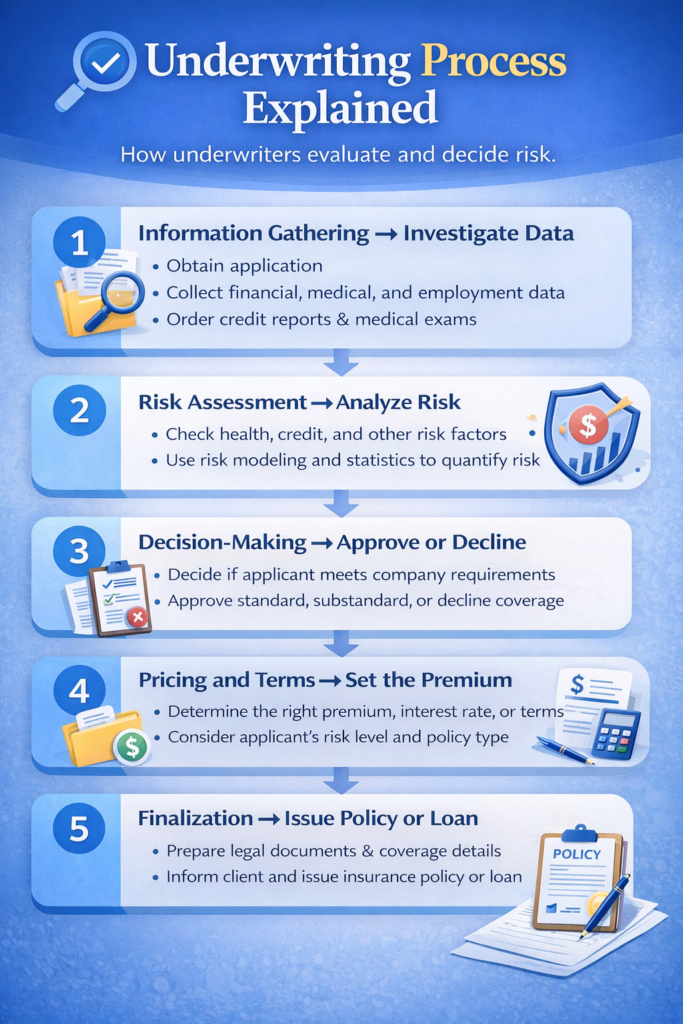
The underwriting process is systematic and varies depending on the type of financial product. Here’s a breakdown:
Step 1: Application Submission
- Client submits an insurance, loan, or mortgage application
- Includes personal, financial, and relevant supporting documents
Step 2: Data Collection
- Credit scores, medical records, property appraisals, and employment verification
- Additional questionnaires or risk assessments if required
Step 3: Risk Analysis
- Evaluate the likelihood of default, claims, or loss
- Use statistical models, risk tables, and software tools
Step 4: Decision Making
- Approve, reject, or approve with adjustments
- Determine coverage limits, loan amounts, or interest rates
Step 5: Documentation and Policy Issuance
- Finalize contracts, policies, or loan documents
- Communicate terms and conditions to the client
Step 6: Monitoring and Review
- Some policies or loans require periodic review
- Adjust terms or premiums based on changes in risk
Example: A mortgage underwriter examines credit score, employment stability, and debt-to-income ratio before approving a loan.
Underwriter Job Description
An underwriter job description varies by industry but generally includes:
Key Responsibilities:
- Assess insurance, loan, or investment applications
- Determine risk levels and approve or reject applications
- Set appropriate premiums, interest rates, or terms
- Maintain records for compliance and auditing
- Collaborate with agents, brokers, and financial analysts
- Monitor portfolio performance and recommend adjustments
Required Skills:
- Analytical and mathematical skills
- Attention to detail
- Knowledge of regulations and compliance standards
- Proficiency with underwriting software and risk models
- Strong communication and decision-making skills
Career Path:
- Junior Underwriter → Underwriter → Senior Underwriter → Underwriting Manager → Chief Risk Officer
Pro Tip: Underwriters combine technical expertise with judgment, making their role critical in finance and insurance.
Types of Underwriters
There are several types of underwriters, each specializing in different areas:
1. Insurance Underwriters
- Life, health, property, casualty, and auto insurance
- Evaluate applications and set premiums based on risk
2. Mortgage Underwriters
- Assess loan applications for home purchases
- Verify creditworthiness, property value, and repayment ability
3. Loan Underwriters
- Personal, business, or auto loans
- Evaluate risk and determine loan approval, interest rates, and repayment terms
4. Securities Underwriters
- Assist companies issuing stocks or bonds
- Evaluate market conditions, set initial pricing, and sell securities
5. Commercial Underwriters
- Large-scale business insurance or financing
- Analyze company financials, operations, and risk exposures
Insight: Each underwriter type requires specific knowledge of regulations, industry standards, and risk assessment tools.
Skills and Tools for Underwriters in 2026
- Analytical Tools: Excel, SAS, underwriting software
- AI & Machine Learning: Automates risk assessment and data analysis
- Financial Modeling: For loan and investment underwriting
- Regulatory Knowledge: Comply with local, state, and federal laws
- Communication Skills: Explain complex decisions to clients or agents
Pro Tip: Adapting to digital tools and predictive analytics is essential for underwriters in 2026.
Common Challenges Underwriters Face
- High Volume of Applications
- Managing thousands of applications efficiently
- Managing thousands of applications efficiently
- Fraud Detection
- Identifying false or misleading information
- Identifying false or misleading information
- Regulatory Compliance
- Keeping up with constantly changing rules
- Keeping up with constantly changing rules
- Economic Uncertainty
- Adjusting risk assessments during market volatility
- Adjusting risk assessments during market volatility
- Balancing Risk and Profitability
- Approving profitable yet low-risk policies or loans
- Approving profitable yet low-risk policies or loans
Solution: Use AI-based tools, continuous training, and robust policies to mitigate these challenges.
Underwriting Metrics to Track
| Metric | Importance | How to Measure |
| Approval Rate | Efficiency | % of applications approved |
| Loss Ratio | Profitability | Claims paid vs premiums collected |
| Turnaround Time | Process efficiency | Average days to assess application |
| Default Rate | Risk management | % of loans that default |
| Compliance Score | Regulatory adherence | Audits passed / errors identified |
Monitoring these metrics ensures quality underwriting and financial stability.
Example of Underwriting Decision
Scenario: John applies for life insurance. The underwriter evaluates:
- Age: 35
- Health: Non-smoker, mild hypertension
- Occupation: Office job, low-risk
- Lifestyle: Moderate exercise, healthy diet
Decision: Approve with standard premium + slight surcharge for mild hypertension.
Takeaway: Underwriters carefully assess multiple factors to balance risk and profitability.
Evolving Trends in Underwriting 2026
- AI and Machine Learning – Risk predictions and automated approvals
- Big Data Analytics – Evaluating historical trends and patterns
- Digital Platforms – Faster processing and better customer experience
- Regulatory Tech (RegTech) – Ensuring compliance through software
- Customized Risk Products – Personalized insurance or loan terms
Insight: Modern underwriting is tech-driven, data-focused, and customer-centric.
Insurance and Finance Underwriter Career Guide
An underwriter in insurance or finance is responsible for analyzing risk and deciding whether a company should approve insurance coverage or financial loans. To become one, start by studying fields like finance, economics, business administration, or accounting. These subjects help you understand financial statements, risk evaluation, and market trends, which are essential for underwriting decisions.
You should also develop strong analytical and decision-making skills. Underwriters review data such as credit reports, financial records, and risk profiles, so being comfortable with numbers and tools like Excel or basic data analysis is very helpful. Many professionals begin their careers in entry-level roles such as underwriting assistant, loan processor, or risk analyst before moving into full underwriting positions.
Getting professional certifications can also improve your career opportunities. Programs offered by organizations like The Institutes (CPCU) or Chartered Insurance Institute can increase your expertise and credibility in the insurance and finance industry. With experience and specialized knowledge, underwriters can grow into senior roles with strong salary potential.
FAQ Section
1. What is the underwriter meaning in insurance?
An underwriter is a professional who assesses risk, decides whether to approve insurance applications, and determines terms and premiums.
2. What does an underwriter do?
They evaluate applications for insurance, loans, or securities, set terms, manage risk, and ensure compliance with regulations.
3. What is the underwriting process?
The underwriting process includes application submission, data collection, risk analysis, decision making, documentation, and monitoring.
4. What skills are needed for an underwriter?
Analytical ability, knowledge of financial and insurance principles, attention to detail, regulatory knowledge, and proficiency with underwriting tools.
5. What types of underwriters exist?
Insurance, mortgage, loan, securities, and commercial underwriters, each specializing in a particular domain.
6. Is underwriting automated in 2026?
Yes, AI, machine learning, and predictive analytics are increasingly used to automate parts of the underwriting process.
7. Why is underwriting important?
Underwriting protects financial institutions from losses by ensuring they accept only applications that meet risk and profitability criteria.
Expert Advice for Aspiring Underwriters
- Gain Industry Knowledge – Learn insurance policies, financial products, and risk management
- Develop Analytical Skills – Master data interpretation and decision-making
- Stay Updated on Technology – Use AI, big data, and automated underwriting systems
- Understand Regulations – Know local and international compliance standards
- Build Communication Skills – Effectively explain underwriting decisions to clients and stakeholders
Final Verdict: Underwriters in Insurance and Finance 2026
Underwriters are critical gatekeepers in insurance, loans, and financial markets. They:
- Evaluate risk for institutions
- Set premiums, interest rates, and loan terms
- Ensure compliance and profitability
- Protect both the organization and its clients
With AI, analytics, and digital tools reshaping the industry, underwriters must combine technical expertise with judgment and communication skills to succeed in 2026.
Take Action
- Understand the underwriter’s role before applying for insurance or loans
- If pursuing a career, develop analytical and industry-specific skills
- Learn about digital underwriting tools for efficiency
- Stay informed on risk management and regulatory updates
Pro Tip: Underwriting expertise ensures better financial decision-making and long-term stability for institutions and individuals alike.
